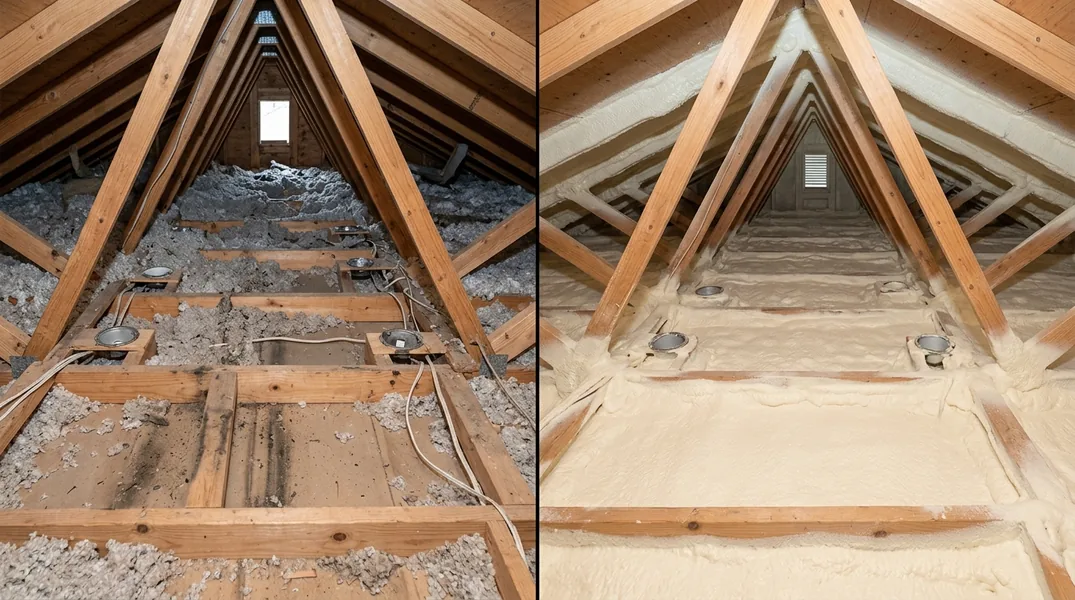
Understanding the Difference Between Air Sealing and Spray Foam
When homeowners in Madison think about improving their attic insulation, they often face a critical decision: should they invest in air sealing alone, or go all-in with spray foam? These are two distinct approaches to the same problem, and understanding the difference is essential before you commit your budget.
Air sealing focuses on closing gaps, cracks, and holes where conditioned air escapes from your home. This might include sealing around ductwork, electrical penetrations, rim joists, and other common leak points. It's a targeted approach that addresses specific problem areas. Attic Spray Foam Insulation, by contrast, creates a comprehensive thermal and air barrier across your entire attic space. Spray foam fills cavities, seals gaps as it expands, and provides both insulation and air sealing in one application. The choice between them depends on your current insulation condition, budget, and long-term energy goals.
When Air Sealing Alone May Be Sufficient
If your attic already has adequate insulation at or near the recommended R-value for your climate zone, air sealing might be the most cost-effective next step. Madison homeowners in the Midwest typically need R-38 to R-60 insulation depending on their specific location and heating demands. If you're already close to these targets but notice drafts, energy bills creeping up, or visible gaps around penetrations, sealing those leaks can yield immediate results without the expense of adding new insulation material.
Air sealing is also the right choice if your attic has blown-in cellulose or fiberglass that's settled over time but still provides reasonable coverage. A professional can identify where warm air is escaping (often around electrical outlets, ductwork, and the attic hatch), seal those areas, and potentially add a thin layer of additional insulation in low-coverage spots. This approach costs significantly less than a full spray foam retrofit and can improve your home's efficiency by 10 to 15 percent in many cases. It's particularly appealing for homeowners who want to maximize their return on investment before pursuing more comprehensive upgrades.
Why Full Spray Foam Makes Sense for Many Attics
Open Cell Spray Foam Insulation and Closed Cell Spray Foam Insulation offer advantages that go beyond simple air sealing. Spray foam insulation R value per inch ranges from about 3.5 to 7 depending on the type, meaning you can achieve higher R-values in less space. For attics with limited headroom or complex geometries, this efficiency is invaluable. Additionally, spray foam creates a monolithic air barrier that eliminates the possibility of missed gaps, which is common with traditional air sealing alone.
If your attic is severely under-insulated, has existing moisture issues, or features irregular framing and numerous obstacles, spray foam becomes the more practical solution. It conforms to every surface, fills around wiring and ductwork, and provides both thermal and moisture resistance in one application. Many homeowners in the region find that the energy savings and comfort improvements justify the higher upfront cost, especially when factoring in available incentives. The longevity of spray foam (typically 80+ years) also means fewer future upgrades compared to traditional insulation that may settle or degrade.
Spray Foam Insulation R Value Per Inch and How Thick Should Spray Foam Be
The thickness of spray foam you need depends on your target R-value, the type of foam, and local building codes. Open cell foam typically delivers about 3.5 to 3.6 R-value per inch, while closed cell foam ranges from 6 to 7 per inch. To meet Midwest insulation standards of R-38 to R-60, you might need 11 to 17 inches of open cell foam, or 6 to 9 inches of closed cell foam. The denser closed cell option is more expensive but requires less thickness and provides superior moisture resistance, making it ideal for older homes or those in damp climates.
Your contractor will calculate the exact thickness needed based on your attic dimensions, existing insulation, and energy efficiency goals. How thick should spray foam be also depends on whether you're insulating just the attic floor (for conditioned space below) or the roof deck (if you're creating a conditioned attic). Local building codes and energy codes in Wisconsin may also influence minimum requirements. When you request a free estimate from Madison Spray Foam Insulation, our team will assess your specific situation and recommend the right thickness to maximize your return on investment.
Tax Credits, Rebates, and Attic Spray Foam Insulation Cost in Madison
The upfront cost of spray foam insulation is higher than traditional air sealing or blown-in fiberglass, but several financial incentives can offset that expense. The federal insulation tax credit allows homeowners to claim up to 30 percent of the cost of qualifying energy-efficient home improvements, including spray foam insulation, on their federal income taxes. Additionally, many utility companies and state programs offer insulation rebates to encourage energy efficiency upgrades. Wisconsin and local utilities serving the Madison area frequently have rebate programs that can reduce your net cost by hundreds or even thousands of dollars.
The typical pricing for attic spray foam in Madison ranges from $1.50 to $3.50 per board foot for open cell foam and $2.50 to $4.50 per board foot for closed cell foam, depending on thickness, accessibility, and local market rates. A typical 1,000 square foot attic might cost $1,500 to $4,500 for spray foam, compared to $500 to $1,500 for air sealing alone. However, when you factor in the insulation tax credit and available rebates, your actual out-of-pocket expense becomes much more competitive. We recommend checking with your utility provider and reviewing current federal tax incentives before making your final decision. Contact Madison Spray Foam Insulation at (608) 292-6626 to discuss your options and learn what rebates or credits you may qualify for.
Making the Right Choice for Your Home
Choosing between air sealing and full spray foam insulation ultimately depends on your home's current condition, your budget, and your long-term comfort and energy goals. If your attic is already reasonably insulated but has visible air leaks, air sealing is a smart, cost-effective first step. If your attic is severely under-insulated, poorly ventilated, or has complex geometry that makes traditional insulation difficult, spray foam is the more comprehensive solution that will deliver lasting results.
Many homeowners find that a hybrid approach makes sense: seal critical air leaks first, then evaluate whether additional insulation is needed. Your contractor can help you prioritize improvements based on energy loss patterns and your budget constraints. Whatever path you choose, the investment in better attic insulation pays dividends through lower heating and cooling costs, improved comfort, and increased home value. If you're ready to explore your options, Madison Spray Foam Insulation is here to help. Call us at (608) 292-6626 or request a free estimate today to discuss which approach is right for your home.
Looking for a professional spray foam insulation contractor in Madison? Madison Spray Foam Insulation responds fast for all your spray foam insulation needs.
Get a Free Quote