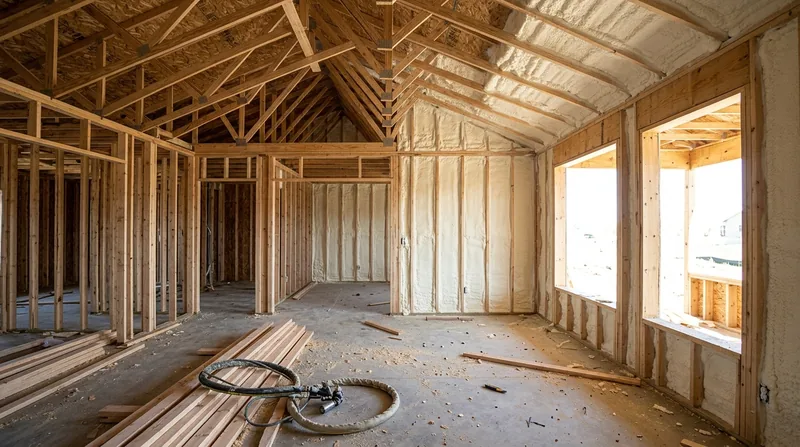




Commercial and new construction spray foam insulation in Madison starts before the drywall closes. Builders across Dane, Sauk, and Columbia counties work with us to meet the energy code that applies at their address, whether that's a two-story subdivision in Fitchburg, a commercial shell in Sun Prairie, or a mixed-use project on the Isthmus. New construction is where spray foam earns its reputation: the product is installed in a controlled environment before mechanical systems and finishes go in, the substrate is clean and dry, and the thickness and R-value are specified and verified before inspection. We work with general contractors, developers, and property managers to deliver foam that performs from day one.
Why Spray Foam Insulation Matters in New Construction and Commercial Projects Across Madison
New construction in Madison and the surrounding counties must meet Wisconsin's energy code, which requires a specified R-value in walls, attics, and other thermal boundaries. Spray foam delivers that performance in a single step: it seals air leaks, insulates, and creates a continuous thermal barrier without gaps or thermal bridging. In a two-story home in Middleton or a commercial warehouse in Verona, the difference between foam and fiberglass shows up immediately in blower door tests, heating bills, and comfort during the first winter. Builders choose foam because it passes inspection faster, reduces callbacks, and gives homeowners a tangible energy advantage from move-in day.
- We spray closed cell foam in walls, rim joists, and band joists to create an air-tight thermal envelope and stop condensation on cold surfaces.
- We spray open cell foam in attics and vented roof cavities where breathability matters and cost efficiency is the priority.
- We coordinate with framers, electricians, and inspectors to hit the spray window before drywall or sheathing closes the wall.
- We provide written estimates with R-value and thickness specs so the builder and inspector know exactly what they are getting.
- We work in new single-family homes, multi-unit residential, commercial shells, metal buildings, and retrofit projects across the region.
Spray foam in new construction is not a premium add-on; it is the standard that meets code and performs.
Key info: Madison's building code requires an R-value in walls (typically R-13 to R-21 depending on construction type and zone), and spray foam delivers that in a single pass. The local building department issues the final sign-off on thickness and coverage, and we coordinate with the inspector before foam cures so nothing is hidden.
For more detail on how spray foam fits into your project, see our page on air sealing and thermal barriers.
How We Work with Builders and Contractors in Madison
New construction spray foam requires coordination with the general contractor's schedule, the building permit process, and the local inspector's requirements. We start with a site visit to understand the framing, the R-value target, the spray window (the time between framing and drywall), and any special requirements such as ignition barriers or thermal barriers mandated by code. We then provide a written estimate with the foam type (closed cell or open cell), the R-value per inch, the total thickness in each zone, and the board-foot count. On spray day, we bring our equipment, our crew, and our ventilation rig to manage fumes during cure. We coordinate with the builder and the inspector so the inspector can verify coverage and thickness before anything is closed up.
- We meet with the builder and the project superintendent to confirm the spray window and any code-specific requirements for your address.
- We provide a written estimate with R-value, thickness, and board-foot specs so the builder knows the cost and the performance upfront.
- We arrive on schedule with a full crew and mechanical ventilation to manage odor and off-gassing during the 24 to 48-hour cure window.
- We stay on site or remain reachable during cure so the builder can coordinate the next trade without guessing when foam is ready for drywall.
- We provide documentation of the work (photos, board-foot count, R-value per zone) for the builder's warranty file and the inspector's record.
This process protects the builder, meets code, and gives the homeowner or tenant a home that performs as designed.
Example: A new subdivision in Sun Prairie with 40 homes, all with 2x6 walls and a sealed attic. The builder needs walls at R-21 (closed cell, 3.5 inches) and the attic at R-49 (open cell, 12 inches). We estimate the whole project, spray in phases as homes frame, coordinate with the inspector on each phase, and the builder moves to drywall on schedule with no surprises.
For commercial projects, see our metal building and barndominium insulation page for more on larger-scale work.
Spray Foam Methods for New Construction and Commercial Work
| Approach | Description | Best for |
|---|---|---|
| Closed Cell Spray Foam | High-density foam (3.5 to 4 lb/ft3) that cures rigid and air-tight. R-value of 6 to 7 per inch. Provides air seal, vapor barrier, and structural support. | Exterior walls, rim joists, band joists, and cold roof decks where condensation risk is high and air sealing is non-negotiable. |
| Open Cell Spray Foam | Low-density foam (0.5 to 1 lb/ft3) that cures spongy and breathable. R-value of 3.6 per inch. Allows drying and permits vapor transmission. | Attics, vented roof cavities, and interior walls where breathability reduces moisture risk and cost efficiency is a priority. |
| Injection Foam (Wall Retrofit) | Low-expansion foam injected into existing wall cavities through small holes. Fills the cavity without demolition. Can be closed cell or open cell. | Retrofit of pre-1980 homes with uninsulated or thin walls. Delivers R-value in place without removing siding or drywall. |
| Attic and Roof Deck Sealing | Spray foam applied to rim joists, band joists, and the attic floor or sealed roof deck to stop air leaks and condensation. Often paired with blown-in insulation above. | New construction attics, sealed roof decks, and retrofit of existing attics where the goal is to stop stack effect and ice dam risk. |
Commercial and New Construction Spray Foam Cost in Madison: What to Expect
Spray foam pricing for new construction and commercial projects in Madison depends on the foam type (closed cell or open cell), the R-value target, the total board-foot volume, and the accessibility of the spray zones. A free commercial estimate is the starting point: we visit the site, measure the walls and attic, confirm the energy code requirement for your address, and provide a written quote with R-value, thickness, and board-foot count. Closed cell foam (R-6 to R-7 per inch) costs more per board foot than open cell (R-3.6 per inch), but closed cell delivers condensation control and structural value in cold climates like Madison. Open cell in an attic is the cost-efficient choice for new construction when the attic is vented or when the code allows it.
Factors that move the price include the total square footage of walls and attic, the height of the building (multi-story work requires scaffolding or lifts), the complexity of the framing (lots of rim joists, band joists, or mechanical chases add time), and the distance from our shop in Madison. A single-family home in Middleton with 2x6 walls and a sealed attic might run $3,500 to $6,000 for closed cell walls and open cell attic; a commercial warehouse in Fitchburg with metal studs and a large roof deck might run $8,000 to $15,000 or more depending on square footage and access. Getting 2 to 3 estimates from different contractors is always smart: compare the R-value per zone, the thickness, the board-foot count, and the warranty terms so you know you are comparing the same work.
See our pricing page for a full breakdown and to request your free commercial estimate today.
What to Look for When Hiring a Spray Foam Insulation Contractor Near Madison
Hiring a spray foam contractor for new construction or a commercial project requires the same diligence as any trade: verify insurance, check references, confirm the estimate includes R-value and thickness specs, and understand what happens if something goes wrong during cure. A good contractor arrives with a written estimate that names the foam type, the R-value per inch, the total thickness in each zone, and the board-foot count. The contractor should explain the spray window (the time between framing and drywall or sheathing), the ventilation plan during cure (mechanical exhaust to control fumes), and the re-entry window (typically 24 to 48 hours). The contractor should also confirm that they are fully insured and that their insurance covers spray foam work on your project.
Ask for references from at least two recent new construction or commercial projects in Madison or the surrounding area. Call those references and ask about the contractor's punctuality, the quality of the spray, whether the inspector had any issues with coverage or thickness, and whether the homeowner or builder would hire them again. Verify that the contractor understands the local building code and the permit process at your address: permitting and contractor registration vary from city to city across Greater Madison, so ask the contractor to confirm what applies to your project and to defer to the local building department on any questions about ignition barriers, thermal barriers, or ventilation requirements.
Red flags include an estimate with no R-value or thickness listed, a price far below the market with no inspection or warranty, a promise of immediate re-entry before 24 hours have passed, and insurance that cannot be verified. The cheapest estimate is rarely the best value in spray foam: you are paying for controlled application, the correct ratio and drum temperature, mechanical ventilation during cure, and a contractor who is reachable if the smell lingers or the foam does not cure as expected.
Ready to move forward with your new construction or commercial project? Contact us for a free estimate and we will walk you through the process.
Commercial & New Construction Spray Foam in Madison: Pricing Guide
| Service | Price | Details |
|---|---|---|
| Free commercial estimate | Free | On-site visit, R-value and thickness specs, board-foot count, written quote, no obligation to book |
| Closed cell spray foam (walls, rim joists, roof decks) | Starting at $1.25 to $2.00 per board foot | Varies by thickness, R-value target, and access; high-density air seal and condensation control in cold climate |
| Open cell spray foam (attics, vented cavities) | Starting at $0.60 to $1.00 per board foot | Cost-efficient attic and roof cavity insulation; breathable, lower R-value per inch, suitable for vented assemblies |
| Commercial or large-scale new construction project | On estimate | Multi-story buildings, metal studs, large roof decks, and complex framing require site verification before pricing |
| Travel and coordination | Included | In Madison and surrounding Dane, Sauk, and Columbia county areas; no separate mileage or call-out fee |
Indicative pricing, the exact cost depends on square footage, finish, and site access. Free personalized estimate within 24h at (608) 292-6626.


