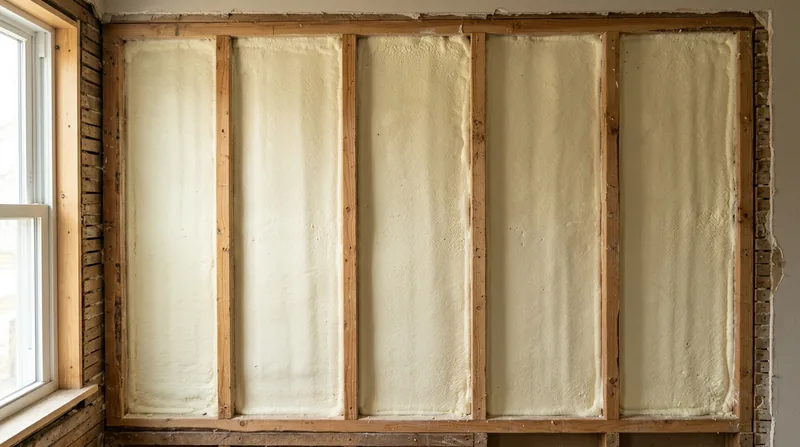




Open cell spray foam insulation in Madison fills wall cavities and attic spaces with a flexible, breathable air seal that works with the humidity swings of Dane County's cold winters and warm summers. Unlike closed cell foam, open cell expands freely to fill stud bays and rafters in older homes near Willy Street and Monroe Street, cutting drafts without the weight penalty of denser products. Madison's residential stock splits sharply by era: balloon-framed homes with uninsulated or thin wall cavities need the gentle fill of open cell, while mid-century attics with settled fiberglass and vented rim joists leak air and moisture that drive heating bills and summer humidity into living spaces. Open cell foam seals those cavities and lets moisture vapor move through the foam itself, reducing the condensation risk that plagues rim joists and attic edges in our climate. We remove failed insulation, spray open cell to specification, and air-seal the leaks that foam alone cannot plug. Call us at (608) 292-6626 for a free written estimate with R-value and thickness specs, or visit our attic spray foam insulation page to see how we handle the signature job of the trade.
Why Open Cell Spray Foam Matters in Madison's Older Homes and Mid-Century Stock
Madison's heating season runs long and cold, and the stack effect pulls warm, moist indoor air upward through leaky attics and into rim joists where it meets cold exterior walls. Fiberglass batts settle over decades, leaving gaps at the top plates and around can lights where air escapes and frost forms in winter. Open cell foam fills those voids completely, expanding to seal stud bays and rafter cavities without adding structural weight or trapping moisture against wood. In humid summers, when outdoor air carries moisture into basement walls and crawl spaces, open cell foam's permeability allows that vapor to dry back out, reducing rot risk in older homes where moisture control is as critical as air sealing.
- Open cell foam expands to fill irregular cavities in balloon-framed homes near the Isthmus, sealing drafts that fiberglass misses at corners and band joists.
- The flexible cell structure allows vapor transmission, so moisture does not trap against wood in our humid summers, cutting condensation and rot in rim joists.
- Open cell foam costs less per board foot than closed cell, making it the right choice for attic top-ups and wall retrofits where R-value-per-dollar matters most.
- We spray at controlled thickness per pass, maintain proper drum temperature and ratio, and require twenty-four to forty-eight hours before re-entry, ensuring the foam cures correctly and odor dissipates.
These four factors make open cell the practical choice for retrofitting Madison's older residential stock without the cost premium or weight penalty of closed cell products.
Key info: Wisconsin building code requires thermal and ignition barriers on spray foam in attics and walls. The fifteen-minute thermal barrier distinction is governed by your local building department, not by us. Always check with the Madison city building inspector or your town clerk before spray work begins, and we help you navigate what applies at your address.
For more on how open cell compares to closed cell in our climate, see our closed cell spray foam insulation page.
How We Spray Open Cell Foam: The Madison Process and Local Examples
We start with a site visit to measure cavities, identify air leaks, and confirm that the substrate is dry and clean. Wet walls, active roof leaks, or standing water in crawl spaces stop the job immediately; we fix the moisture first or we walk away. Once the space is ready, we set up mechanical ventilation to control odor during cure, spray the foam at the manufacturer-specified ratio and drum temperature, and mark the thickness to specification. A typical attic retrofit in Fitchburg or Sun Prairie takes one to two days, depending on cavity size and access. After spraying, we seal rim joists and top plates with caulk or additional foam, and you stay out of the space for twenty-four to forty-eight hours while the foam cures and off-gasses.
- We inspect the attic or wall cavity for moisture, active leaks, or contamination before any foam is sprayed.
- We set up mechanical ventilation during the spray and cure phases to manage odor and ensure proper curing conditions.
- We spray open cell at the correct thickness per pass, maintaining the drum temperature and ratio that the manufacturer specifies for your climate zone.
- We air-seal rim joists, band joists, top plates, and penetrations with caulk or foam to close the gaps that foam alone cannot reach.
- We provide a written estimate with R-value and thickness specs before we start, so you know exactly what you are getting.
This step-by-step approach ensures that open cell foam performs as designed and that the cure window is respected so odor does not linger in your home.
Real example: A 1960s ranch home in Monona with a vented attic and settled R-11 fiberglass. The rim joists sweat every winter, and the attic edges frost over. We removed the old batts, sprayed open cell to R-20 in the attic rafter bays, and sealed the rim joists with closed cell foam because that junction needs the moisture barrier. Total cost on estimate, job took one day, re-entry the next morning. No smell after forty-eight hours, heating bills down measurably by the next winter.
Learn more about air sealing and how it works alongside spray foam to close the leaks that foam alone cannot plug.
Open Cell vs. Closed Cell: Choosing the Right Foam for Your Madison Home
Open cell and closed cell foam are different products built for different jobs. Open cell expands freely to fill cavities, costs less per board foot, and allows moisture vapor to pass through, making it ideal for attics and interior wall retrofits where breathability matters. Closed cell is denser, carries a higher R-value per inch, and blocks moisture, making it the right choice for rim joists, band joists, and metal building condensation control where moisture sealing is critical. In Madison's climate, a typical retrofit combines both: open cell in the attic and interior walls, closed cell at the rim joist and band joist where the cold exterior meets warm interior air.
| Approach | Description | Best for |
|---|---|---|
| Open Cell Foam | Flexible, breathable, expands to fill cavities, R-3.5 to R-3.8 per inch, allows vapor transmission. | Attic retrofits, interior wall cavities, sound dampening, homes where moisture control is passive. |
| Closed Cell Foam | Dense, rigid, R-6 to R-7 per inch, blocks moisture and air, provides structural bracing. | Rim joists, band joists, metal buildings, crawl spaces, areas where moisture sealing is critical. |
| Blown-In Fiberglass Top-Up | Loose-fill insulation, R-2.2 per inch, no air sealing, simple and low-cost. | Adding depth to sound attic insulation where air sealing is not the primary need. |
| Insulation Removal and Replacement | Complete removal of failed, settled, or contaminated insulation, followed by new spray foam or blown-in product. | Attics with decades of settled fiberglass, moisture-damaged batts, or previous spray foam that has failed. |
The choice between open cell and closed cell is not a preference; it is dictated by the use. We recommend both for most Madison homes, and we always explain which foam goes where and why.
Open Cell Spray Foam Insulation Cost in Madison: What to Expect
Open cell spray foam is priced by the board foot, measured on site at the thickness and coverage you specify. A typical starting rate is $0.55 to $0.75 per board foot, depending on the size of the job, access to the cavity, and whether we are removing old insulation first. A 1,500-square-foot attic sprayed to R-20 in open cell runs roughly 3,000 to 3,500 board feet, so a ballpark cost is $1,650 to $2,625 before any air sealing or removal work. Wall retrofits in older homes near Willy Street or Monroe Street, where we inject foam into closed cavities, run higher because drilling and sealing each bay adds labor. Crawl space work in homes with concrete floors and rim joists can run $2,500 to $5,000 depending on the square footage and moisture conditions.
Three factors move the cost up or down: first, whether we remove old insulation (add $0.50 to $1.50 per square foot depending on material and depth); second, the complexity of access (tight attics with low headroom or knee walls cost more to spray safely); third, whether the substrate is wet or contaminated (we stop and walk away, but fixing the moisture first adds time and cost). Always get two or three written estimates with R-value and thickness specs before deciding. A low price with no detail is a red flag; a high price with no explanation is also suspect.
Visit our full pricing page for detailed breakdowns by service type, or call us at (608) 292-6626 for a free estimate tailored to your home.
What to Look for When Hiring a Spray Foam Insulation Contractor Near Madison
The spray foam market in Greater Madison includes local independents, national franchises, and rig-and-run crews that spray a job in an afternoon and disappear when the smell will not go away or the foam fails. Verify any contractor's insurance and ask to see the certificate of insurance naming your address as an additional insured; fully insured is the minimum, not a luxury. Get written estimates with R-value and thickness specs from at least two contractors, and be skeptical of any estimate that leaves those details blank or quotes a price far below market with no inspection. Ask for references from jobs in Madison, Fitchburg, or Verona completed in the last two years, and call them to confirm the work, the timeline, and whether the contractor was reachable after the job.
Check whether your city requires a spray foam insulation permit or contractor registration. Madison, Middleton, and Fitchburg each have different rules, and there is no reciprocity across Dane County. Call your local building department or town clerk to confirm what applies at your address, and ask whether the contractor you are considering is registered or in good standing. If you have an HOA, check the architectural rules for any restrictions on exterior work or metal building insulation. Most HOAs do not touch interior insulation, but master-planned communities sometimes govern the appearance of additions or outbuildings.
Red flags include: an estimate with no R-value or thickness, no mechanical ventilation mentioned during cure, immediate re-entry promised (we require twenty-four to forty-eight hours), insurance that cannot be verified, or a price far below market with no on-site inspection. The honest position, which is also the strongest selling point, is correct installation: controlled thickness per pass, the manufacturer ratio and drum temperature, mechanical ventilation during cure, and a stated re-entry window that is respected. Contact us for a free estimate and we will walk you through the process, answer your questions about permits and insurance, and explain exactly what we are spraying and why.
Open Cell Spray Foam Insulation in Madison: Pricing Guide
| Service | Price | Details |
|---|---|---|
| Open Cell Spray Foam, Attic Retrofit | Starting at $0.55/board ft | Typical 1,500 sq ft attic sprayed to R-20 runs 3,000 to 3,500 board feet, roughly $1,650 to $2,625 before removal or air sealing |
| Open Cell Spray Foam, Wall Retrofit or Injection | Starting at $0.65/board ft | Closed cavity injection in older homes costs more due to drilling and sealing each bay; typical retrofit $2,000 to $4,500 depending on wall area |
| Insulation Removal (prerequisite to spray) | Starting at $0.50 to $1.50/sq ft | Removal of settled fiberglass, failed foam, or contaminated batts adds labor; cost depends on material type and attic access |
| Air Sealing and Rim Joist Closure | Starting at $1,200 to $2,500 | Sealing rim joists, band joists, top plates, and penetrations with caulk or closed cell foam, critical for moisture control in Madison |
| Written Estimate with R-Value and Thickness Specs | Free | Response within 24 hours at (608) 292-6626, no obligation to book, includes site inspection and detailed specification |
Indicative pricing, the exact cost depends on square footage, finish, and site access. Free personalized estimate within 24h at (608) 292-6626.


