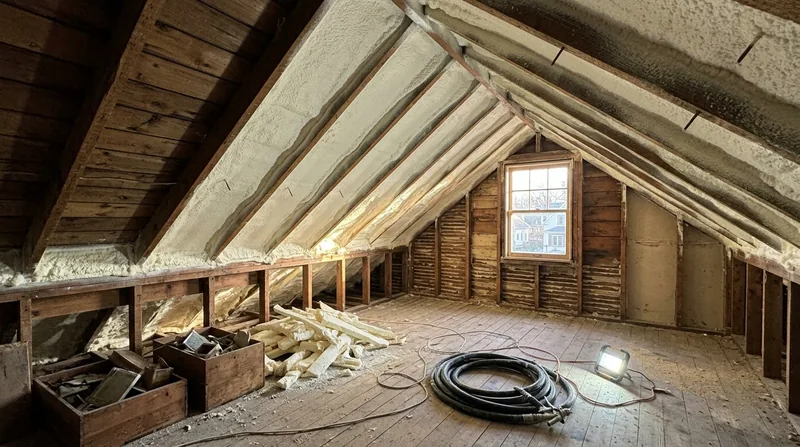




Older homes on the Isthmus between Lake Mendota and Lake Monona, and mid-century houses across Dane County, often carry insulation that has settled, failed, or was never adequate for Madison's winters. Fiberglass batts compress over decades, cellulose settles and stops blocking air, and foam installed without proper technique leaves thermal gaps and condensation problems. Insulation replacement and re-insulation in Madison means removing what no longer works and installing spray foam sized for the climate zone and your home's air leakage points. We pull out the old material, seal the framing, and spray closed cell or open cell foam into attics, walls, crawl spaces, and rim joists so your heating season runs efficient and your summer humidity stays under control. This is the foundational retrofit that stops ice dams, cuts stack-effect losses, and lets you actually feel the difference when the thermostat drops.
Why Insulation Replacement Matters in Madison's Cold Climate
Madison winters demand insulation that stays in place and maintains its R-value year after year. Settled fiberglass in attics, thin wall cavities in balloon-framed homes on Willy Street and Monroe Street, and uninsulated rim joists are the three biggest heat loss pathways in this region. When old insulation fails, your heating system runs longer, condensation forms at cold surfaces, and ice dams back up water into the roof line every winter. Replacement insulation must be sized correctly, installed without voids, and positioned to stop both the stack effect through your attic and the infiltration at rim joists and band joists where warm interior air meets cold exterior framing.
- We remove settled or failed insulation completely, including old fiberglass batts, cellulose, and spray foam that was installed without proper sealing.
- We seal air leakage pathways before installing new foam, stopping the stack effect that pulls warm air straight up and out through your attic.
- We install spray foam at the correct thickness and density for attic decks, wall cavities, and crawl space rim joists so you get the R-value your estimate specifies.
- We provide written estimates with R-value and thickness so you know exactly what you are paying for and why the price sits where it does.
The result is a home that holds heat in winter, resists humidity in summer, and stops the ice dam and condensation cycle that wears out roofing and framing.
Key info: Madison's residential stock splits sharply by era. Balloon-framed homes in older neighborhoods like Maple Bluff and Shorewood Hills have thin uninsulated wall cavities and rim joists that frost over in winter. Mid-century ranch homes across Sun Prairie and Fitchburg carry attics with settled batts and sealed can lights that feed ice dams. Newer two-story builds toward Verona and Middleton have vented attics and leaky top plates. All three types benefit from insulation replacement, but the scope and method depend on what is already there and what your building department requires for ventilation and thermal barriers. Check your local building code at your city's permit office before we arrive.
For more on what drives energy loss in Madison homes, see our attic spray foam insulation service page.
How Insulation Replacement Works: Our Process in Madison
Insulation replacement starts with a site visit and a clear estimate showing what comes out, what goes in, and the R-value you will get. We assess the existing material, identify air leakage points, determine whether the space needs closed cell or open cell foam, and confirm what your local building code permits for ventilation and thermal barriers. Once you approve the estimate, we schedule the work, protect your belongings and HVAC equipment, remove the old insulation into sealed bags, seal the framing and air pathways, and spray the new foam in controlled passes to reach the thickness and density specified in your estimate. The whole process typically takes one to three days depending on the scope, and we follow a re-entry window of twenty-four to forty-eight hours before normal occupancy.
- We inspect and document the existing insulation and identify settlement, moisture, air leaks, and any contamination that must be removed.
- We pull out old material into sealed bags and haul it away, leaving the framing clean and ready for new foam.
- We seal air pathways around can lights, penetrations, rim joists, and top plates with foam or caulk before spraying the main insulation.
- We spray foam at the correct temperature and ratio, in multiple thin passes rather than one thick pour, to avoid shrinkage and voids.
- We provide mechanical ventilation during cure and specify a re-entry window so you know when the home is safe to occupy normally.
This methodical approach ensures the insulation stays in place, performs at its rated R-value, and does not create moisture or off-gassing problems after installation.
Local example: A 1960s ranch in McFarland with 4 inches of settled fiberglass in the attic and no rim joist insulation loses heat constantly through stack effect and infiltration. We remove the batts, seal the rim joists and top plates with closed cell foam, and install 6 inches of open cell foam over the attic deck. The result is an R-value of approximately R-20 in the rim joist and R-19 to R-21 in the attic, a typical upgrade for mid-century homes in this region. The homeowner stops seeing frost on rim joists in January and no longer needs to rake ice dams off the eaves.
For details on air sealing as part of the replacement process, visit our air sealing service page.
Insulation Replacement Methods: Choosing the Right Approach
| Approach | Description | Best for |
|---|---|---|
| Closed Cell Foam Replacement | High-density foam at 3.5 to 4 pounds per cubic foot, providing R-6 to R-7 per inch, excellent air and moisture barrier, requires 15-minute thermal barrier or ignition barrier per code. | Rim joists, band joists, crawl spaces, and attics where moisture control and maximum R-value per inch is critical. Also metal buildings and barndominiums where condensation on steel is the failure mode. |
| Open Cell Foam Replacement | Lower-density foam at 0.5 pounds per cubic foot, providing R-3.5 to R-4 per inch, air seal with vapor permeability, allows drying to interior, no thermal barrier required if sprayed 3.5 inches or thicker. | Attics in vented assemblies, wall cavities where drying to the interior is desired, and budget-conscious replacements where R-value per dollar is the priority over condensation control. |
| Injection Foam into Existing Walls | Low-pressure injection of closed cell or open cell foam into wall cavities through small holes, no demolition required, fills cavities and seals rim joists from inside. | Balloon-framed homes on the Isthmus and pre-1980 construction where wall cavities are thin, uninsulated, or contain only air. Allows retrofit without tearing out plaster or drywall. |
| Crawl Space Rim and Band Joist Sealing | Closed cell foam sprayed on rim joists, band joists, and rim board to stop infiltration and condensation at the foundation line where warm interior air meets cold concrete and framing. | Any crawl space or basement in Madison's climate where stack effect and moisture control are priorities. Often the entry point for a full attic and wall replacement later. |
Insulation Replacement and Re-Insulation Cost in Madison: What to Expect
Insulation replacement pricing depends on the square footage of the attic or wall cavity, the depth and type of foam required, whether old insulation must be removed, and the accessibility of the space. A typical attic replacement in Madison starts at $2,800 for a modest single-story home and scales upward for larger footprints, two-story construction, and complex roof lines. Rim joist and band joist sealing, often bundled with attic work, adds $800 to $1,500 depending on the linear footage. Wall injection foam in a balloon-framed home on the Isthmus costs more per board foot because access is limited and drilling is required, but avoids demolition and is often the only retrofit option for occupied homes. Crawl space replacement with closed cell foam on rim joists typically runs $1,200 to $2,400 for a standard foundation perimeter.
The factors that move the price up or down are straightforward: larger attics cost more because they require more material and labor; difficult access (steep roofs, tight crawl spaces, or obstructed attics) adds time; removal of old insulation adds cost but is non-negotiable because new foam will not stick to wet, dusty, or contaminated surfaces; and the choice of closed cell versus open cell affects the per-board-foot rate. We provide a written estimate with R-value, thickness, and total square footage so you can compare apples to apples and understand exactly what you are paying for. For detailed pricing on specific scopes, see our pricing page.
Getting two or three estimates from different contractors is smart. Verify that each estimate includes the removal cost, the foam type and thickness, the R-value delivered, and any warranties on workmanship. Avoid any estimate that omits these details or quotes a price per board foot without a site visit, because spray foam is measured on site and a firm price without inspection is a sign of poor practice.
What to Look for When Hiring a Spray Foam Insulation Contractor Near Madison
Hiring the right contractor for insulation replacement is as important as the material choice itself. Madison's building stock is diverse, and the rules for ventilation, thermal barriers, and permits vary by city and by the age of your home. A good contractor understands these local differences, pulls or helps you navigate permits, and can explain why closed cell or open cell is the right choice for your specific situation. Avoid any contractor who promises immediate re-entry, skips mechanical ventilation during cure, quotes a price without a site visit, or cannot provide insurance documentation and references.
- Verify that the contractor is fully insured and can provide a current certificate of liability before work begins.
- Request written estimates from at least two contractors that include foam type, thickness, R-value, removal cost, and a timeline.
- Ask for references from recent jobs in Madison, Middleton, Fitchburg, or nearby towns, and call them to ask about the quality, timeline, and any issues after installation.
- Confirm that the contractor understands your city's permit requirements and thermal barrier or ventilation rules, and is willing to work with your local building department.
- Check that the estimate specifies a re-entry window of twenty-four to forty-eight hours and includes mechanical ventilation during cure, not just passive air movement.
The local independent contractor with a local address and local plates is positioned differently than the national franchise or the rig-and-run crew from out of state. We have been in Madison since 2016, we are fully insured, and we stand behind our work with a one-year workmanship warranty. If something goes wrong, you can reach us by phone at (608) 292-6626, not a call center in another state. Contact us for a free estimate and a clear conversation about what your home needs.
To request a free estimate or discuss your insulation replacement project, contact Madison Spray Foam Insulation today.
Seasonality and Timing for Insulation Replacement in Madison
Madison's insulation replacement work peaks in late fall and early spring, when homeowners are preparing for winter or recovering from it. However, the best time to schedule a replacement is actually late summer or early fall, before the heating season arrives and before ice dams and condensation reveal the problem. If you wait until January, when frost appears on rim joists and ice dams form along the eaves, the work is still urgent but the weather is harder and crews are booked solid. Spring is the second-best window because the damage is visible and the weather is warming, making cure and ventilation easier. Summer is possible but less common because homeowners are focused on cooling and outdoor projects. Winter work is doable but adds cost and scheduling complexity due to snow, cold, and the need for temporary ventilation during cure. Plan ahead and call (608) 292-6626 in August or September to schedule a fall replacement so you are ready for the cold.
Insulation Replacement & Re-Insulation in Madison: Pricing Guide
| Service | Price | Details |
|---|---|---|
| Attic insulation replacement (single story) | Starting at $2,800 | Removal of old fiberglass or cellulose, sealing, and 5 to 6 inches of open cell foam, typical R-value R-18 to R-21 |
| Rim joist and band joist sealing | Starting at $1,200 | Closed cell foam on foundation rim and band joist, prevents infiltration and condensation, scales with linear footage of perimeter |
| Wall injection foam retrofit (balloon-frame homes) | Starting at $3,500 | Drilling, injection of closed or open cell foam into wall cavities, no demolition, cost depends on wall area and cavity condition |
| Crawl space rim joist replacement | Starting at $1,200 | Closed cell foam on rim joists and band joists, moisture barrier and air seal, typical crawl space foundation perimeter |
| Two-story attic replacement or complex roof line | On estimate | Larger square footage, difficult access, or multiple roof planes require site inspection to determine material and labor scope |
| Free estimate and site visit | No charge | Response within 24 hours at (608) 292-6626, includes written quote with R-value, thickness, and removal cost specified |
Indicative pricing, the exact cost depends on square footage, finish, and site access. Free personalized estimate within 24h at (608) 292-6626.


