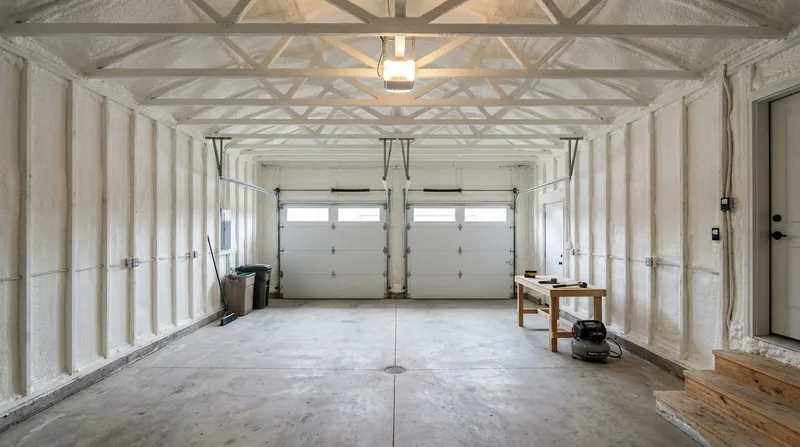




Attached garages across Madison's subdivisions in Fitchburg, Sun Prairie, and Middleton lose heat through uninsulated walls and ceilings every winter. Homeowners notice the cold immediately: a garage that never warms above 40 degrees, pipes that freeze, and conditioned air from the house bleeding through shared walls into an unconditioned space. Garage spray foam insulation in Madison seals those walls and ceilings so your attached garage holds heat through the long Wisconsin winter, protects plumbing, and stops the stack effect that pulls warm air out of your home. We have been insulating garages and sealing air leaks across Dane County since 2016, and we know exactly where Madison's garages leak and how to fix them with spray foam that stays in place.
Why Garage Insulation Matters in Madison's Cold Climate
Madison winters run long and hard, with temperatures dropping well below zero for weeks at a time. An uninsulated attached garage is a thermal sieve: it draws conditioned air from your house, cools it, and forces your furnace to work harder. Heat escapes through the rim joist, the top plate where the garage roof meets the wall, and the shared wall between garage and house. Spray foam closes all three paths at once, and it does the job permanently because foam does not settle, compress, or absorb moisture the way fiberglass does.
- Uninsulated garage walls lose heat 5 to 8 times faster than insulated walls in Madison's winter climate.
- Foam stops air infiltration at the rim joist, top plate, and wall cavities in a single pass, with no gaps.
- A sealed garage protects water pipes from freezing and prevents ice dams along the garage roof line.
- Closed cell foam (the denser type) resists moisture better than open cell in garages where humidity and condensation are concerns.
- Spray foam bonds to wood, metal, and concrete, so it works on any garage frame or foundation.
Getting your garage insulated before the next winter cycle stops the heat loss that has been running up your bills every year.
Local example: A two-car attached garage in Fitchburg with 2-inch foam on the walls and ceiling runs roughly 20 to 25 degrees warmer in January than an uninsulated garage next door. Homeowners report noticing the difference within the first week of cure.
How We Insulate Garages in Madison: The Process
Garage foam jobs follow a straightforward sequence: we inspect the garage frame and foundation to find air leaks and weak spots, measure the walls and ceiling, choose the right foam type for your use case, and spray in controlled passes. The work takes one day for most residential garages, and the foam cures in 24 to 48 hours. We provide a written estimate with R-value and thickness specs before we start, so you know exactly what you are getting.
- We walk the garage, identify rim joists, shared walls with the house, and any existing air leaks or moisture concerns.
- We measure wall height, ceiling area, and any obstructions like trusses or electrical panels.
- We choose closed cell or open cell based on your garage use: closed cell for garages with high humidity or metal buildings, open cell for finished garages where sound dampening and lower cost matter more.
- We set up mechanical ventilation during the spray and cure phase to manage isocyanate vapor.
- We spray in two to three thin passes rather than one thick pass, so the foam expands and cures evenly without voids.
- We apply a thermal barrier (typically latex paint) to meet code fire safety requirements.
The job is complete when the foam has cured and we have cleaned up all equipment and debris.
Madison example: A Sun Prairie homeowner with a detached garage that had settled over decades, leaving gaps at the rim joist and top plate, got 3 inches of closed cell foam on all walls and 2 inches on the ceiling. The garage temperature stayed above 32 degrees all winter, and the water heater inside never froze again.
Closed Cell vs. Open Cell: Which Foam is Right for Your Madison Garage
Closed cell and open cell spray foam are different products for different jobs. Closed cell is denser, carries a higher R-value per inch, and resists moisture, so it is the standard for garages with humidity, metal buildings, and cold climates where condensation is a real risk. Open cell is lighter, cheaper, and better at sound dampening, so it works well for finished garages where you want quiet and do not have a moisture concern. Madison's long winters and the risk of condensation on rim joists and cold walls makes closed cell the safer choice for most attached garages, but we assess your specific use case and tell you plainly which one makes sense.
| Approach | Description | Best for |
|---|---|---|
| Closed Cell Spray Foam | Dense, high R-value (6.5 to 7 per inch), resists moisture and air infiltration, acts as a vapor barrier. | Unheated or semi-heated garages in Madison, rim joists, metal buildings, and any space where condensation or high humidity is a concern. |
| Open Cell Spray Foam | Lower density, moderate R-value (3.5 to 4 per inch), breathable, better sound dampening, lower cost. | Finished or climate-controlled garages where moisture is not a concern and sound insulation adds value. |
| Hybrid or Two-Layer Application | Closed cell on rim joists and high-moisture zones, open cell on walls and ceiling for cost and sound. | Large garages or mixed-use spaces where budget and performance both matter. |
| Existing Insulation Top-Up | Foam applied over old fiberglass or mineral wool to fill gaps and improve air sealing without full removal. | Garages with partial insulation that needs upgrading or air sealing without a complete tear-out. |
We write up the foam type and thickness in your estimate so you understand the performance difference before we start.
Garage Spray Foam Insulation Cost in Madison: What to Expect
Garage spray foam insulation in Madison starts at roughly $1,200 for a single-car garage with 2 inches of closed cell foam on the walls and ceiling. A two-car garage typically runs $1,800 to $2,400, depending on wall height, ceiling configuration, and whether the rim joist is exposed or buried. Factors that move the cost up include taller walls, vaulted or truss ceilings, existing insulation that needs removal, and access challenges like narrow doors or tight spaces. We charge for spray foam by the board foot, measured on site, so the final price depends on your garage's actual dimensions and the thickness you choose.
Getting two or three written estimates from local contractors is always smart. Make sure each estimate includes R-value and thickness specs, so you are comparing the same product and performance. A price that is far below market, an estimate with no R-value or thickness listed, or a contractor who promises immediate re-entry without mechanical ventilation during cure are all red flags. Visit our pricing page for more detail on what moves costs in your specific situation, and call us at (608) 292-6626 for a free written estimate with no obligation.
What to Look for When Hiring a Spray Foam Insulation Contractor Near Madison
Madison's spray foam market includes local independent shops, regional franchises, and out-of-state crews that spray a job in an afternoon and disappear. The local independent is your best bet because we are reachable when questions come up, we know the local building code and permitting rules, and we stake our reputation on every job we do in Dane County. When you call a contractor, ask for proof of current insurance, a written estimate with R-value and thickness, and the name of a recent local reference you can actually call. Verify that the contractor understands Madison's permit requirements for your address, and ask whether they handle mechanical ventilation during cure and apply a thermal barrier to meet fire code.
- Request a written estimate that lists R-value per inch, total thickness, foam type, and the square footage or board feet being sprayed.
- Confirm the contractor carries liability insurance and can provide a certificate of insurance before work starts.
- Ask about the re-entry window and mechanical ventilation during cure; honest contractors tell you 24 to 48 hours and explain why ventilation matters.
- Call a recent reference and ask whether the contractor showed up on time, cleaned up after, and remained reachable if questions arose.
- Verify that the contractor understands your local building department's thermal barrier and ignition barrier rules for your address.
We are fully insured and have been serving Madison and Dane County since 2016. Call us for a free estimate at (608) 292-6626, and we will walk you through the whole process.
Garage Spray Foam Insulation in Madison: Pricing Guide
| Service | Price | Details |
|---|---|---|
| Single-car garage, 2-inch closed cell foam | Starting at $1,200 | Walls and ceiling insulated, rim joist sealed, written estimate includes R-value and thickness |
| Two-car garage, 2-inch closed cell foam | Starting at $1,800 | Standard two-car dimensions, rim joist sealed, thermal barrier applied, varies by ceiling height and existing obstruction |
| Large garage or mixed foam application | Starting at $2,400 | Vaulted ceilings, hybrid closed and open cell, or existing insulation removal required, priced per board foot on site |
| Insulation removal and replacement | On estimate | Old fiberglass or failed foam tear-out, disposal, and new foam application, cost depends on volume and contamination |
| Travel and estimate | Free and included | No mileage charge in Madison and surrounding Dane County areas, written estimate with no obligation to book |
Indicative pricing, the exact cost depends on square footage, finish, and site access. Free personalized estimate within 24h at (608) 292-6626.


