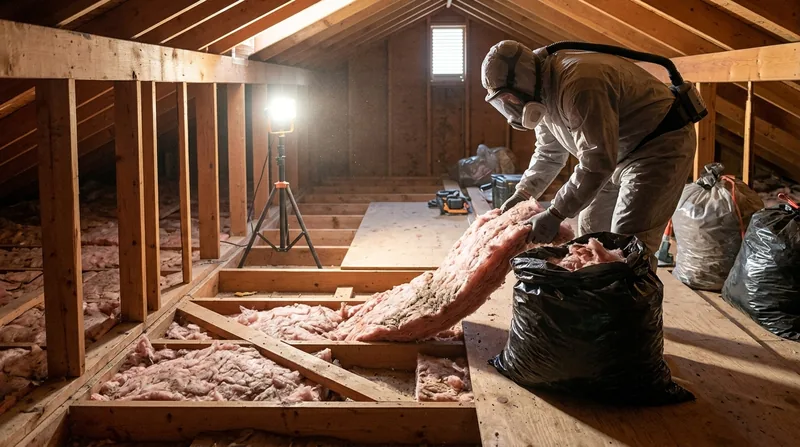




Attic insulation in mid-century Dane County homes often settles, mats down, or holds decades of rodent damage. Insulation removal in Madison is the first step before new foam goes in, and it is the difference between a retrofit that works and one that fails. On the Isthmus and across Fitchburg, Middleton, and Sun Prairie, we remove old fiberglass, blown-in cellulose, and failed foam from attics and walls before spray foam insulation takes its place. The cold winters and stack effect that drive your heating bills also drive moisture and condensation into rim joists and attic edges. Removing deteriorated insulation and air-sealing the substrate is the only honest way to stop that cycle. We have been doing this work since 2016, and we do not spray over old material that is wet, contaminated, or compromised.
Why Insulation Removal Matters in Madison's Older Housing Stock
Madison's residential core splits sharply by era and location. Balloon-framed homes along Willy Street and Monroe Street, built before 1950, sit over full basements with thin or missing wall cavity insulation and rim joists that frost and sweat every winter. Mid-century ranch and split-level homes across Dane County carry attic insulation that has settled over forty or fifty years, matted down to half its original thickness, and often contaminated by rodent nesting or urine. Newer subdivisions toward Middleton and Sun Prairie have vented attics with settled fiberglass and engineered trusses that still leak air at top plates and rim band joists. The long, cold winters and the stack effect that drives warm, moist air upward mean that old, failed insulation becomes a moisture trap, not a barrier. Removing it and starting fresh with spray foam is the only way to restore the thermal and moisture control that the original builder did not provide.
- We remove settled, matted, or contaminated attic insulation before spray foam retrofit goes in.
- We handle fiberglass, cellulose, and failed foam removal from walls, crawl spaces, and rim joists across Greater Madison.
- We inspect the substrate for moisture, rodent damage, and structural integrity before removal begins.
- We dispose of all removed material in compliance with local regulations and Wisconsin solid waste rules.
- We do not spray foam over wet, leaking, or contaminated substrates; we fix the moisture issue first or we do not proceed.
Proper removal is the foundation of a spray foam job that will not fail, and it is the single most common step that rig-and-run crews skip to save time and money.
Key info: Mid-century homes in Madison often have attic insulation that has settled to 2 to 3 inches of compressed fiberglass, losing 40 to 60 percent of its R-value. Blown-in cellulose absorbs moisture and becomes a rodent habitat. Removal and replacement with closed-cell spray foam restores R-value and eliminates the moisture trap. See our attic spray foam insulation page for sealed attic details.
For more information on contractor standards and permitting in Wisconsin, consult the Wisconsin Department of Safety and Professional Services, which oversees home improvement contractor registration and consumer protections.
How We Remove Insulation in Madison: A Step-by-Step Process
Insulation removal is not demolition, but it requires discipline and the right equipment. We start with a site inspection to identify the type and condition of existing material, check for moisture, rodent damage, and structural issues, and confirm access and containment needs. We then set up temporary barriers and mechanical ventilation to keep dust and debris contained and out of living spaces. We remove material systematically by section, bag it, and stage it for disposal. Finally, we inspect the bare substrate, repair any damage, seal air leaks and penetrations, and prepare the surface for foam application.
- We inspect the attic or wall cavity for moisture, rodent nesting, structural damage, and the type of insulation present.
- We set up plastic sheeting and mechanical exhaust to contain dust and maintain air quality during removal.
- We remove all insulation material by hand or vacuum, working methodically from one end of the space to the other.
- We bag and stage all removed material for proper disposal according to Wisconsin waste regulations.
- We inspect the bare substrate for water stains, rot, rodent droppings, and any penetrations that need sealing.
- We seal air leaks around ductwork, wiring, and rim joists before foam application begins.
This preparation work is invisible to the homeowner but determines whether the foam job will last and perform as designed.
Local example: A 1970s ranch home in Fitchburg with a 1,200-square-foot attic had 6 inches of settled fiberglass and rodent damage in the northeast corner. Removal took one day, included repair of the damaged rafter tail and rim joist, and revealed a missing soffit baffle that was feeding ice dams every winter. The removal cost was part of the sealed attic retrofit that followed.
Learn more about our air sealing process, which runs in parallel with insulation removal to stop drafts and moisture infiltration.
Insulation Removal Methods and Equipment
| Method | Description | Best for |
|---|---|---|
| Hand removal with containment | Insulation removed by hand into bags, with plastic sheeting and exhaust fan to control dust. | Attics with moderate contamination, tight access, or where minimal structural disturbance is needed. |
| Vacuum extraction | Blown-in cellulose or loose fiberglass vacuumed into a collection tank mounted on a truck. | Large attics with uniform blown-in insulation and good access for a vacuum hose. |
| Selective demolition | Removal of batts or blankets from walls or attics using hand tools, with immediate air sealing of cavities. | Wall cavity retrofit, injection foam preparation, or attics with batt insulation and exposed framing. |
| Substrate repair and prep | After removal, sealing of penetrations, repair of water-damaged lumber, and correction of air leaks. | All removals, to ensure foam substrate is dry, sound, and properly sealed before application. |
Insulation Removal Cost in Madison: What to Expect
Insulation removal costs in Madison range from a few hundred dollars for a small attic top-up to several thousand for a full-house retrofit with wall cavity and crawl space work. The starting point for a typical 1,000 to 1,200-square-foot attic removal is around $950 to $1,500, depending on insulation type, depth, contamination, and accessibility. Blown-in cellulose is lighter and faster to vacuum than batts; rodent-contaminated attics require extra care and disposal fees; tight access or low headroom adds labor. Crawl space removal is more expensive per square foot because of moisture control, structural complexity, and disposal logistics. Wall cavity removal for injection foam retrofit is a smaller, more precise job and is usually priced per linear foot of wall or per cavity.
The best way to understand what a removal will cost at your address is to get a written estimate that includes the square footage, the insulation type and depth, the disposal method, and the labor hours. We provide written estimates with R-value and thickness specs, and we do not charge for the estimate. Most jobs are quoted within 24 hours of your call to (608) 292-6626. The estimate also tells you what the substrate condition is and whether any repairs or moisture fixes are needed before foam goes in.
For detailed pricing on removal, re-insulation, and foam application, see our full pricing overview.
What to Look for When Hiring an Insulation Removal Contractor Near Madison
Insulation removal is a straightforward job, but it is also a step that many contractors rush or skip, and it is worth hiring someone who takes it seriously. When you are comparing contractors near Madison, look for a company that does a site inspection before quoting, provides a detailed written estimate with square footage and material type, and explains what happens to the removed material. Ask whether they will inspect and air-seal the substrate before foam application, and whether they carry full insurance that covers the removal and the follow-up spray foam work. Check references from recent jobs in your neighborhood, Madison, Middleton, or Fitchburg, and ask those homeowners whether the crew was clean, whether the work took the time promised, and whether the substrate was properly prepared.
Avoid contractors who quote a price over the phone without seeing the space, who promise immediate re-entry after foam application, who offer a price far below market with no inspection, or who cannot provide proof of insurance. Many cities in Greater Madison require contractor registration or a home improvement license; verify that your contractor holds the registration required at your address by contacting your local building department. If you are in a homeowner association, check whether HOA approval is needed for interior work. Most insulation removal does not require a permit, but some municipalities require notification to the building department if hazardous materials like asbestos are suspected; we will advise you if that applies to your job.
Get in touch with us for a free estimate: call (608) 292-6626 or visit our contact page to request an inspection and quote. We will tell you exactly what needs to come out, why, and what the cost will be.
Insulation Removal in Madison: Pricing Guide
| Service | Price | Details |
|---|---|---|
| Attic insulation removal (typical) | Starting at $950 | 1,000 to 1,200 sq ft attic, hand or vacuum removal, disposal included, substrate inspection |
| Crawl space insulation removal | Starting at $1,200 | Includes moisture assessment, selective removal, and preparation for closed-cell foam application |
| Wall cavity removal for injection foam retrofit | Starting at $400 per wall | Labor and debris removal for selective cavity prep, typically 200 to 400 linear feet of wall |
| Full-house removal with repairs and air sealing | On estimate | Attic, walls, crawl space, rim joist, and structural repairs require site inspection and detailed scope |
| Travel | Included | Madison and surrounding service areas, no mileage charge or travel fee applied to estimate |
| Estimate | Free | Written estimate with R-value, thickness, square footage, and disposal plan, response within 24 hours |
Indicative pricing, the exact cost depends on square footage, finish, and site access. Free personalized estimate within 24h at (608) 292-6626.


