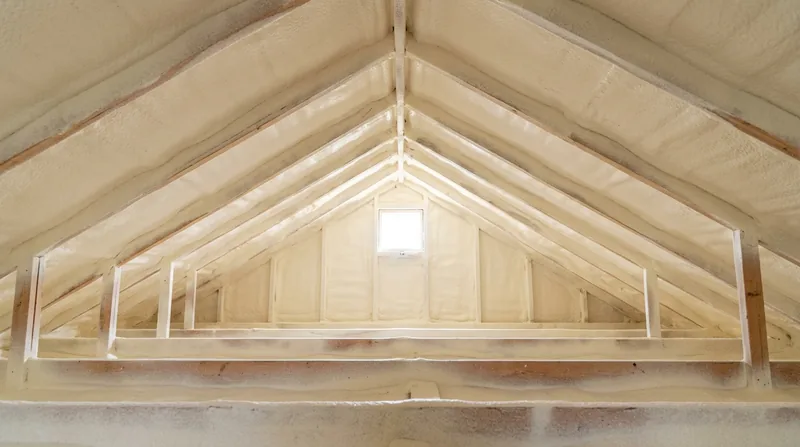




Attic spray foam insulation in Madison stops the ice dams and heating losses that plague homes built on the Isthmus and across Dane County. Madison attics take a beating from deep winter snow load and the long cold winters that drive warm moist air into uninsulated rim joists and cold attic edges. We build a continuous air barrier sized to Dane County's winters, air seal top plates before foam goes in, and leave no thermal bypass for stack effect to exploit. Whether your home sits in the balloon-framed stock near Willy Street, a mid-century ranch with settled insulation toward Fitchburg, or a newer two-story subdivision in Sun Prairie, the failure mode is the same: warm interior air escapes to the attic, condenses on cold surfaces, and feeds ice dams every January through March. Spray foam stops that leak at the source. We remove failed insulation where needed, install closed cell or open cell foam to specification, and air seal every penetration before you re-enter the space.
Why Attic Spray Foam Insulation Matters in Madison's Cold Climate
Madison winters run long and wet. Snow sits on roofs for weeks, ice dams form at the eaves, and the warm air leaking from your attic accelerates the melt that backs water into walls and ceilings. The Isthmus homes with full basements and balloon framing lose heat through rim joists and band joists faster than any other path in the house. Mid-century construction across the county sits with attic insulation that has settled over thirty or forty years, leaving gaps at top plates and around can lights where conditioned air escapes unchecked. Sealed attics with spray foam stop that air leakage, eliminate ice dam risk, and lower the heating load that drives your January and February bills higher than anywhere else in the year.
- We install foam to the R-value and thickness that Dane County's heating demand requires, specified in writing before work begins.
- Air sealing top plates, rim joists, and all penetrations prevents the stack effect that pulls warm moist air into the attic cavity.
- A continuous thermal and air barrier eliminates the cold surface that condensation needs to form ice dams or frost the rim joist.
- Closed cell foam holds its R-value over decades without settling, unlike blown-in fiberglass that compacts and loses performance as it ages.
- Mechanical ventilation during cure and a stated re-entry window of twenty-four to forty-eight hours ensure the space is safe and the foam cures to full density.
The result is a winter attic that stays dry, a basement rim joist that no longer sweats, and a heating bill that reflects the insulation value you paid for. For more on how air sealing works alongside foam, visit our air sealing service page.
Madison reality: A home on Maple Bluff with a vented attic and R-19 fiberglass from 1978 loses heat through the rim joist and top plate faster than through the attic itself. Spray foam to the rim and air sealing the band joist stops the stack effect that pulls that warm air out. The attic insulation itself comes second.
Wisconsin's building code governs attic ventilation, ignition barriers, and thermal barrier requirements based on your address and local jurisdiction. Always check with your city building department before work starts. Madison, Middleton, Fitchburg, and Verona each have their own permitting rules, and there is no reciprocity between them. We help you understand what applies at your address, but the building official has the final word.
How We Install Attic Spray Foam Insulation in Madison
We start with a written estimate that names the R-value, thickness in inches, and board feet of foam we will install. We inspect the attic for moisture, active leaks, or contamination. If we find wet substrate or standing water, we walk away and refer you to the contractor who fixes the moisture first. Once the space is dry and ready, we air seal every top plate, rim joist, can light, and penetration with foam or caulk before we spray the primary insulation. Mechanical ventilation runs during cure to manage off-gassing. You stay out of the attic for twenty-four to forty-eight hours while the foam reaches full cure.
- We remove settled or failed insulation and any debris that will interfere with foam adhesion to the substrate.
- We air seal all penetrations, top plates, and rim joists with closed cell foam or caulk to stop air leakage before the main insulation goes in.
- We spray closed cell or open cell foam to the thickness and R-value specified in your written estimate, measured in board feet on site.
- We run mechanical ventilation and monitor temperature and humidity during cure to ensure the foam reaches full density and strength.
- We provide a re-entry window and walk you through safe use of the attic once cure is complete.
A typical attic job in Madison takes one to three days, depending on square footage, the amount of air sealing required, and whether we remove old insulation first. For details on insulation removal, visit that service page.
Example job: A 1,400-square-foot attic in Monona with R-19 fiberglass, settled unevenly and with air leaks around three can lights and the rim joist. We remove the old insulation, air seal the rim and can lights, and install closed cell foam to R-38 (5.5 inches). Total board feet, measured on site, runs 770 to 840 depending on truss spacing and obstruction. Cost reflects that measurement, not a per-square-foot guess made before we enter the space.
Attic Spray Foam Insulation Methods and When to Use Each
| Approach | Description | Best for |
|---|---|---|
| Closed Cell Spray Foam | High-density foam (1.5 to 2.0 lbs/cubic foot) that holds R-6 to R-6.5 per inch, resists moisture, and does not settle over time. | Attics where moisture or seasonal humidity is a concern, rim joists, and sealed roof decks in Madison's damp climate. |
| Open Cell Spray Foam | Low-density foam (0.4 to 0.5 lbs/cubic foot) that holds R-3.5 per inch, breathes, and is less expensive than closed cell. | Vented attics where condensation is not a risk and budget is the priority, or sound dampening in garage and workshop spaces. |
| Closed Cell Rim Joist Package | Closed cell foam applied to rim joists, band joists, and the rim cavity, with air sealing of all cracks and penetrations. | Basements in Madison and the Isthmus where frost, sweating, and stack effect are the dominant heating loss path. |
| Blown-In Insulation (Top-Up) | Dense-packed fiberglass or cellulose applied over existing settled insulation where the substrate is sound and air sealing is not required. | Simple attic upgrades where existing insulation is in place, uncontaminated, and no air leaks are visible at top plates or penetrations. |
Each method has a place. Closed cell is the right answer for Madison's rim joists and sealed attics because it handles moisture and does not settle. Open cell costs less and works well in vented attics where the homeowner accepts the need for ventilation and accepts that the foam will eventually compress slightly. Blown-in is sometimes the right answer and we say so plainly: if your attic insulation is sound, air leaks are minimal, and you need a lower-cost upgrade, blown-in is faster and cheaper than foam.
Attic Spray Foam Insulation Cost in Madison: What to Expect
Attic spray foam insulation in Madison starts at approximately $1.50 per square foot for basic open cell application in a straightforward attic with good access and minimal air sealing. Closed cell, which holds R-value better and resists moisture, runs higher because the material cost is higher and the installation is more precise. Factors that move the price up include the amount of air sealing required before foam goes in, whether we remove failed or settled insulation first, attic size and access difficulty, and the R-value you choose. A larger attic with extensive air sealing at rim joists and top plates costs more per board foot than a simple top-up of an already-sound space. We measure foam in board feet on site, not in advance, so the final price reflects what the job actually requires.
- Get written estimates from at least two spray foam contractors that name R-value, thickness, and board feet before any work begins.
- Ask whether the estimate includes air sealing of top plates, rim joists, and penetrations, or whether that is a separate line item.
- Verify that the contractor specifies mechanical ventilation during cure and a re-entry window of twenty-four to forty-eight hours.
- Check whether insulation removal is included or priced separately, and confirm what happens to old material.
- Request a breakdown of labor, material, and any travel or mobilization fees so you understand what you are paying for.
The cheapest estimate is rarely the best one. A bid with no R-value spec, no thickness, no board-foot measurement, and a promise of immediate re-entry is a marker of poor work. For a detailed pricing breakdown and to discuss your specific attic, call us at (608) 292-6626 or visit our pricing page.
Attic Spray Foam Insulation Near Me: What Madison Homeowners Should Know Before Hiring
Finding the right spray foam contractor in Madison means checking more than just the price. The spray foam trade has rig-and-run crews that spray a job in an afternoon and leave town before the curing issues show up, and it has national franchises that subcontract the work to crews that may not be local. The local independent contractor is positioned against both because we stay in Madison, we are reachable when questions arise, and we stand behind our work. Verify any contractor's insurance and ask to see a current certificate. Ask whether they pull permits where required and what the local building department rules are for your address and zip code. Request references from jobs completed in the last two years in Madison, Fitchburg, Monona, or nearby areas, and call at least one to ask about the installation, the cure process, and whether any issues came up afterward.
- Confirm that the contractor is fully insured with current coverage and can provide a certificate of insurance before work starts.
- Ask what permits apply at your address by contacting your city building department, and verify that the contractor understands those requirements.
- Request a written estimate that specifies R-value, thickness in inches, board feet, and the scope of air sealing included.
- Call references and ask about the contractor's professionalism, whether the job stayed on schedule, and whether the contractor was reachable if questions arose after the job.
- Get at least two estimates so you can compare scope, material choice, and price on an apples-to-apples basis.
We are fully insured and have been in business since 2016. We provide written estimates with R-value and thickness specs, mechanical ventilation during cure, and a stated re-entry window. For a free estimate with no obligation, call (608) 292-6626 or contact us online.
Attic Spray Foam Insulation in Madison: Pricing Guide
| Service | Price | Details |
|---|---|---|
| Open Cell Spray Foam Attic | Starting at $1.50/sq ft | Low-density foam for vented attics, includes air sealing of top plates and basic penetrations, measured in board feet on site |
| Closed Cell Spray Foam Attic | Starting at $2.25/sq ft | High-density moisture-resistant foam for sealed attics and rim joists, includes comprehensive air sealing, measured in board feet on site |
| Insulation Removal and Re-Insulation | Starting at $2.00/sq ft | Removal of failed or settled insulation plus new spray foam installation, price reflects attic size, disposal, and foam type chosen |
| Rim Joist and Band Joist Sealing | Starting at $8.00/linear foot | Closed cell foam applied to rim cavity with complete air sealing, typical basement perimeter in Madison runs 120 to 180 linear feet |
| Travel and Mobilization | Included | No separate travel fee for Madison and surrounding Dane County service areas, included in the estimate |
| Free Written Estimate | No charge | Response within 24 hours, on-site inspection, written R-value and thickness specs, no obligation to book, call (608) 292-6626 |
Indicative pricing, the exact cost depends on square footage, finish, and site access. Free personalized estimate within 24h at (608) 292-6626.


