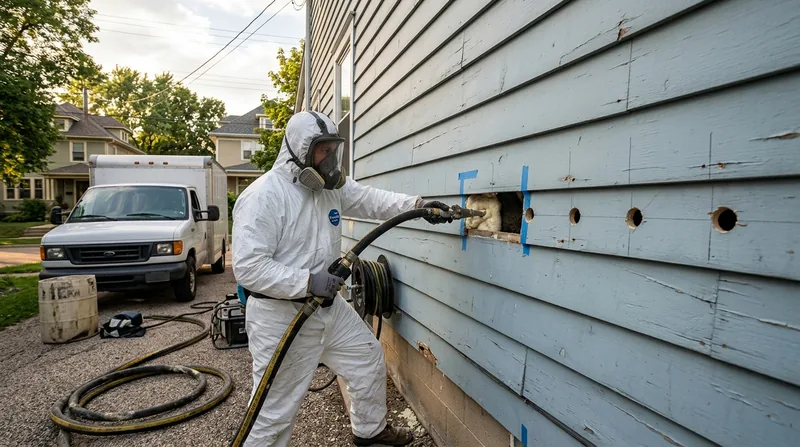




Madison's older homes on the Isthmus and along Willy Street were built with balloon-framed walls and thin or missing cavity insulation. Winter air leaks through those uninsulated wall cavities drive heating loss and cold drafts into living spaces, while summer humidity seeps in through the same gaps. Wall and injection foam insulation fills those closed cavities from outside without opening drywall, sealing the thermal envelope of homes built before modern insulation standards took hold. This is the retrofit that works for pre-1980 stock across Madison, Fitchburg, Verona, and the surrounding Dane County neighborhoods where balloon framing is the rule, not the exception. We drill small holes from the exterior, pump closed-cell foam into the cavities, and patch the siding to match the original finish. The result is a warm, draft-free wall and lower heating bills through the long Wisconsin winters.
Why Wall and Injection Foam Insulation Matters in Older Madison Homes
Madison's residential stock splits sharply by era. Homes built before 1950, especially those on the Isthmus between the lakes and in the UW-Madison rental districts, sit over full basements with exterior walls that were never insulated. The balloon-frame construction of these homes means the wall cavities run continuously from the basement rim joist all the way to the attic, creating a direct thermal path from outside to inside. Winter temperatures drop to 10 degrees Fahrenheit or lower for weeks at a time, and uninsulated walls bleed heat relentlessly. Injection foam stops that loss without tearing open the drywall.
- Fills wall cavities completely without demolition or drywall removal.
- Seals air leaks and moisture entry points in the exterior wall assembly.
- Works on homes with balloon framing, which is common in Madison's pre-1950 housing stock.
- Reduces heating costs by closing the largest uncontrolled thermal bypass in older homes.
- Cures to a rigid foam that resists settling and maintains R-value over decades.
Injection foam is the only practical retrofit for closed wall cavities in Madison's historic neighborhoods, and it delivers measurable warmth and comfort in rooms that have always been cold.
Local example: A 1920s Maple Bluff home on the Isthmus with 2x4 exterior walls and no insulation typically loses 30 to 40 percent of its heating energy through the walls alone. Injection foam into those cavities raises the effective R-value of the wall from R-3 to R-15 or higher, cutting that loss by two-thirds and warming rooms that faced the street or the lake.
How Wall and Injection Foam Insulation Works in Madison
The process is straightforward and non-invasive. We locate the wall cavities by drilling small test holes from the exterior, confirm the cavity is clear and dry, then pump closed-cell foam into the space under controlled pressure. The foam expands to fill voids and seal air leaks, then hardens into a rigid insulation layer. Once cured, we patch the holes with siding that matches the original finish. The entire wall is insulated from outside, and the interior drywall stays intact.
- We inspect the exterior wall to identify the cavity layout and confirm access points.
- We drill small holes (typically 1 to 1.5 inches) from the outside at intervals along the wall.
- We inject closed-cell foam into each cavity section under measured pressure and flow rate.
- We monitor foam expansion to prevent overfilling and pressure buildup inside the wall.
- Once cured (24 to 48 hours), we patch holes with siding caulk or new siding to match the original.
- We perform a final inspection to confirm complete fill and proper patch finish.
The result is a fully insulated wall that performs like modern construction, with no interior disruption and exterior patching that blends seamlessly into the existing siding.
Real scenario: A Shorewood Hills home with 1930s brick exterior and wood frame interior walls had cold spots along the north-facing wall every winter. Injection foam filled the 2x4 cavities behind the brick, raising interior wall surface temperature by 10 to 15 degrees Fahrenheit and eliminating the cold draft. Patching was done with matching mortar and siding caulk, leaving no trace of the work.
For homes with rim joists and band joists that need sealing, injection foam into the rim cavity is often the next step after wall insulation, creating a complete thermal envelope at the foundation.
Wall and Injection Foam Methods and Applications
| Method | Description | Best For |
|---|---|---|
| Closed-Cell Injection Foam | High-density foam pumped into cavities, expands to fill voids, cures rigid and air-tight. | Balloon-frame walls, rim joists, and any closed cavity requiring both insulation and air sealing. |
| Exterior Drilling and Fill | Small holes drilled from outside, foam injected at intervals, holes patched to match siding. | Homes where interior access is not practical or where preserving drywall finish is critical. |
| Interior Cavity Access | Holes drilled from basement or interior, foam injected upward into wall cavities above. | Basement walls and rim joists where exterior access is limited or siding is difficult to patch. |
| Multi-Section Fill | Tall walls divided into sections (top, middle, bottom), each filled separately to ensure complete coverage. | Two-story homes and walls over 12 feet tall where foam flow would otherwise stop mid-cavity. |
Wall and Injection Foam Insulation Cost in Madison: What to Expect
Wall and injection foam insulation in Madison typically starts at $2 per square foot of wall area, though the final price depends on several site-specific factors. A 1,000-square-foot wall section (for example, a two-story exterior wall 25 feet wide and 40 feet tall) would run from $2,000 upward. The cost per square foot can increase if the wall cavities are blocked by fire stops or bridging, if the exterior siding is difficult to patch (such as old brick or specialty materials), or if the home is in a location with limited access. Getting two to three estimates is the best way to understand what your home will actually cost, because cavity layout, siding type, and the condition of the wall assembly vary from house to house.
For a detailed breakdown of injection foam pricing and to see how your home's specifics affect the estimate, visit our pricing overview. We provide written estimates that include the square footage, cavity R-value, and foam thickness specification, so you know exactly what you are paying for.
What to Look for When Hiring a Wall and Injection Foam Contractor Near Madison
Hiring the right spray foam contractor is about verifying credentials, getting multiple bids, and understanding what happens during and after the job. Madison's building code and permit requirements vary by neighborhood, and some homes in historic districts or HOAs may have additional rules about exterior work. Before you call, confirm whether your property is in a protected area or subject to HOA review. Ask any contractor you are considering to explain the permit process for your address, and verify that they carry full insurance coverage.
When you call for an estimate, ask for a written bid that includes the square footage of the wall, the R-value per inch of foam, and the total foam thickness that will be injected. A contractor who cannot or will not provide those numbers is not ready to do the work. Check references from at least two previous jobs in Madison or nearby, and ask those homeowners whether the patching blended well with the existing siding and whether they noticed any odor or off-gassing after the work was done. Proper installation includes mechanical ventilation during cure and a re-entry window of at least 24 to 48 hours, which your contractor should state upfront.
For a free estimate and to discuss your home's specific needs, contact us at (608) 292-6626. We serve Madison, Fitchburg, Verona, Sun Prairie, Monona, and all surrounding Dane County communities, and we provide written specifications before any work begins.
If your walls are insulated but your attic insulation has settled or failed, that is often the next priority for heating efficiency. We handle both jobs as part of a comprehensive energy retrofit.
Wall & Injection Foam Insulation in Madison: Pricing Guide
| Service | Price | Details |
|---|---|---|
| Wall cavity injection, per sq ft | Starting at $2/sq ft | Exterior drilling, closed-cell foam fill, siding patch. Price increases with cavity blocking or specialty finishes. |
| Small wall section (under 500 sq ft) | Starting at $1,000 | Typical two-story exterior wall or single-story section with straightforward cavity access and matching siding. |
| Full-house exterior wall insulation | On estimate | Multi-story, multiple walls, or complex siding requires on-site inspection to determine cavity layout and patch strategy. |
| Rim joist and band joist injection | Starting at $500 | Basement rim cavity fill, typically 1 to 2 feet tall, sealed from interior or exterior depending on access. |
| Travel and site visit | Included | No charge for estimates or travel within Madison and surrounding Dane County service area. |
| Written estimate | Free | Detailed bid with square footage, R-value, thickness, and patching plan. Response within 24 hours. |
Indicative pricing, the exact cost depends on square footage, finish, and site access. Free personalized estimate within 24h at (608) 292-6626.


