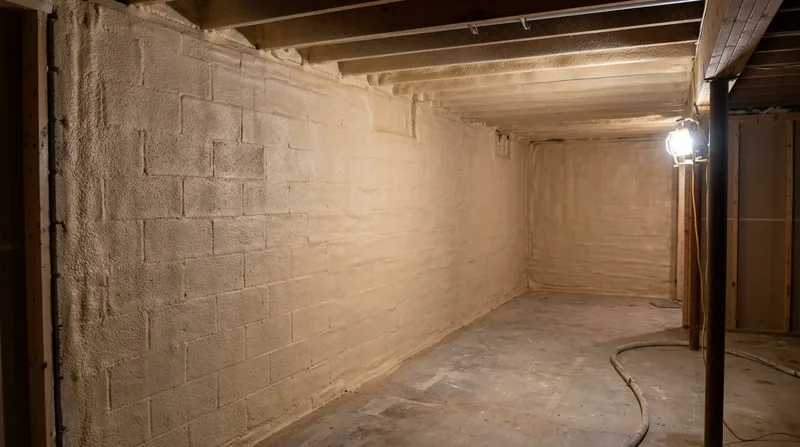




Closed cell spray foam insulation in Madison adds rigid insulation and a vapor retarder to basements, rim joists, and foundation walls across Dane County, closing the gap where warm interior air meets cold concrete. Madison's older stock on the Isthmus, balloon-framed homes along Willy Street and Monroe Street with uninsulated rim joists, sweats and frosts every winter, driving heat loss straight into the foundation. Mid-century homes across the county sit with settled attic insulation and leaky rim details that compound the problem. Closed cell foam seals these thermal breaks, adds structural rigidity to basement walls, and acts as a vapor retarder in a climate where winter indoor air runs dry and summer humidity creeps up from below-grade spaces. We spray it at the rim joist, band board, and foundation walls, controlling thickness and ratio on site to meet code and deliver the R-value you need. The result is warmer floors, lower heating bills, and no sweating rim joists when the temperature drops below freezing.
Why Closed Cell Spray Foam Matters in Madison Basements and Rim Joists
Madison's residential foundation stock splits between full basements with concrete walls and older balloon-framed rim joists that sit directly above grade. Both are cold. Closed cell foam is rigid enough to reinforce a rim joist and dense enough to block moisture vapor, making it the right choice where a basement wall or band board meets the outdoor air. In winter, when interior air is heated and dry, that warm air migrates toward the cold concrete by convection and diffusion, condensing on the rim joist surface and wetting the wood. In summer, humid outdoor air pushes inward through the same path, feeding mold and rot in the band board. Closed cell foam stops both directions of moisture movement and adds insulation value that fiberglass and cellulose cannot match in a thin cavity.
- Closed cell foam delivers R-6 to R-7 per inch, so a 1.5-inch application at the rim joist meets code minimum in many cases without eating floor space.
- The foam adheres to concrete, wood, and steel, creating a continuous air seal and vapor barrier in one pass.
- Moisture does not penetrate closed cell foam, so wet rim joists and sweat-soaked band boards stop within weeks of application.
- The rigid structure reinforces a weak rim joist and stabilizes the rim-to-foundation joint against seasonal movement.
These properties make closed cell the standard for basements and rim joists across Dane County, from Fitchburg to Waunakee to Monona, wherever the foundation sits cold and the wood is at risk.
Key info: Madison's building code (adopted from the Wisconsin Energy Code) requires a thermal barrier on spray foam in occupied spaces. Closed cell foam 1.5 inches thick or thicker needs a 15-minute thermal barrier (drywall, plaster, or intumescent coating) if it faces a basement or garage room. We detail this requirement in every estimate and coordinate with your local building department to confirm what applies at your address.
For more on how rim joists and band boards fail in the cold, see our rim joist and band joist spray foam page.
How We Spray Closed Cell Foam at Your Madison Foundation
Closed cell foam requires precise equipment, trained application, and controlled conditions on site. We measure the rim joist and foundation wall, confirm the substrate is clean and dry, set up mechanical ventilation for the cure period, and spray the foam in passes that match the manufacturer's specifications for thickness and ratio. The process takes one to three days depending on the square footage, and the foam cures hard within 24 to 48 hours. After cure, we trim excess foam flush with the rim or wall and verify the final thickness and R-value on site.
- We inspect the rim joist and foundation for active moisture or standing water before we arrive; if we find either, we address the source or we do not spray.
- We clean the substrate and seal any large cracks or gaps so the foam bonds uniformly and fills the cavity without bridging.
- We set up ducted ventilation during application and cure to manage fumes and ensure indoor air quality during the re-entry window.
- We spray in thin, overlapping passes to control density and thickness, checking our work against the board-foot tally and the R-value target.
- We trim the cured foam flush with the rim or wall and document the final thickness at multiple points so you have a record of what was installed.
The entire process is straightforward and non-invasive; we do not tear out walls or disturb occupied spaces, and we clean up debris on site before we leave.
Example: A 1,200-square-foot basement rim joist in Middleton with a 2-inch closed cell application takes two days on site, including substrate prep, ventilation setup, foam application, cure time, and trim. The homeowner can re-enter the basement 24 hours after we finish spraying. The final R-value is approximately R-12 to R-14, and the rim joist stays dry through the next winter.
For a detailed walk-through of the air sealing process that often accompanies closed cell foam, visit our air sealing page.
| Approach | Description | Best for |
|---|---|---|
| Rim Joist Application | 1.5 to 2 inches of closed cell foam sprayed directly onto the rim board, band joist, and the top 12 inches of foundation wall to create a continuous seal. | Older homes with balloon framing, sweating rim joists, and frost stains on basement ceilings. |
| Full Foundation Wall | 2 to 3 inches of closed cell foam applied to the entire basement wall from rim to floor, adding insulation and vapor control to the entire below-grade envelope. | Finished basements, new construction, and homes where basement rooms are heated or conditioned. |
| Band Joist Only | 1 to 1.5 inches of closed cell foam applied to the exposed band board where it meets the rim, sealing the thermal break without removing or disturbing the rim cavity. | Homes where the rim cavity is already insulated but the band board remains cold and the rim joist continues to sweat. |
| Retrofit Over Existing Insulation | 1 to 2 inches of closed cell foam sprayed over old fiberglass or cellulose in the rim cavity to add insulation value and seal air gaps without removal. | Homes where rim cavity insulation is present but has settled, compressed, or failed to stop air leakage and moisture. |
Closed Cell Spray Foam Insulation Cost in Madison: What to Expect
Closed cell spray foam costs between $1.20 and $1.80 per board foot for material and labor in the Madison area, depending on substrate condition, access, and the thickness you need. A rim joist application on a 1,200-square-foot basement typically runs 400 to 600 board feet and costs $480 to $1,080 before any thermal barrier or trim work. A full foundation wall application runs higher in both board feet and total cost because the wall area is larger. The biggest variables are substrate prep (if we need to clean, seal, or repair cracks before spraying), access (tight crawl spaces or finished basements cost more to set up), and whether you need a thermal barrier applied after cure.
- Substrate condition is the first cost driver: a clean, dry, crack-sealed rim joist takes one day; a wet rim joist or one with active seepage may require drainage or dehumidification before we spray.
- Access determines how we set up ventilation and equipment: a finished basement or a tight crawl space adds labor and staging time compared to an open basement.
- Thermal barrier material and installation add cost if code requires it; drywall over foam runs $3 to $5 per square foot, while intumescent paint is cheaper but requires careful application.
- Travel is included within Madison and the surrounding area; no mileage fees or call-out charges apply.
The best way to lock in an accurate price is to request a free, no-obligation estimate. We measure your rim joist or foundation wall on site, assess substrate condition and access, confirm code requirements with your local building department, and provide a written estimate with R-value and thickness specs. See our pricing page for additional detail on cost factors and examples.
What to Look for When Hiring a Spray Foam Contractor Near Madison
Closed cell spray foam is a precision product, and the quality of the installation depends entirely on the contractor's equipment, training, and attention to detail. A poor installation, wrong ratio, wrong thickness, inadequate ventilation, or immediate re-entry, leaves you with a failed seal, off-gassing, and a costly tear-out. Here is what to verify before you hire any spray foam contractor, including us.
- Confirm the contractor is fully insured and ask to see a certificate of insurance that names your address as an additional insured for the duration of the job.
- Get a written estimate that specifies the R-value you will receive, the foam thickness in inches, and the total board feet to be applied; if an estimate has no thickness or R-value, walk away.
- Ask about ventilation during cure and the re-entry window; any contractor who promises immediate re-entry is cutting corners on safety.
- Check references from recent jobs in Madison, Fitchburg, or Verona; call those homeowners and ask whether the foam stayed dry, whether the smell was manageable, and whether the contractor was reachable after the job.
- Verify that the contractor will help you navigate permitting and code compliance for your specific address; Madison, Middleton, and Sun Prairie each have different thermal barrier and ventilation rules.
- Ask whether the contractor has a local address and local insurance; out-of-state rigs with trailers and crews that move to the next job in an afternoon are the source of most complaints about smell, poor quality, and no follow-up.
If you have questions about our qualifications, insurance, or process, call us at (608) 292-6626 or request a free estimate online. We are fully insured, we provide written estimates with R-value and thickness, and we have a local address and phone number in Madison.
Closed Cell Spray Foam Insulation in Madison: Pricing Guide
| Service | Price | Details |
|---|---|---|
| Rim Joist Application (1.5 to 2 inches) | Starting at $1.20/board ft | Typical 1,200 sq ft basement rim runs 400 to 600 board feet; substrate condition and access affect final cost |
| Full Foundation Wall (2 to 3 inches) | Starting at $1.40/board ft | Larger area and thicker application; finished basements or tight crawl spaces add staging and ventilation labor |
| Thermal Barrier (drywall or intumescent coating) | Starting at $3.00/sq ft | Code-required in Madison for occupied spaces; thickness of foam and local building department rules determine what applies |
| Substrate Prep (cleaning, sealing, moisture control) | On estimate | Wet rim joists or active seepage may require drainage or dehumidification before foam application; site inspection determines scope |
| Travel | Included | No mileage fee or call-out charge within Madison and surrounding Dane County service areas |
| Free Estimate | No charge | Written estimate with R-value and thickness specs; response within 24 hours at (608) 292-6626, no obligation to book |
Indicative pricing, the exact cost depends on square footage, finish, and site access. Free personalized estimate within 24h at (608) 292-6626.


